
De Wetenschap Achter Relatie Compatibiliteit
DNA Romance predicts "chemistry" online using the DRom 1.0 algorithm. It assesses 100 specific markers within your DNA - focused on genes proven to be involved in attraction and reproduction. Studies have shown that people with varied DNA markers in the Major Histocompatibility Complex (MHC) tend to find each other's scent appealing and often enjoy more durable romantic relationships.
DRom 1.0 - Predicting Chemistry

DNA Romance voorspelt ook. Persoonlijkheidscompatibiliteit using Myers-Briggs personality types, lets users evaluate shared common interests via filters, and Fysieke aantrekkingskracht based on photographs.
Our second algorithm, DRom 2.0, uses an AI model trained with relevant DNA markers to predict phenotypic traits with high accuracy - complementing the profile-verification mechanism that checks user authenticity.
Persoonlijkheidscompatibiliteitsbeoordeling
Hoe verschillende persoonlijkheidstypen omgaan in relaties
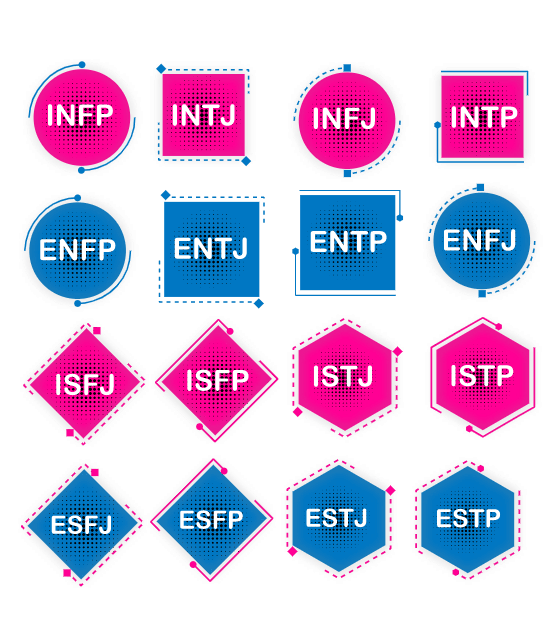
Our personality compatibility rating draws on the Jung / Myers-Briggs 16 personality types a psychometric framework with over a century of development. Carl Jung's 1921 work was refined by Isabel Briggs Myers and Katherine Briggs into the Myers-Briggs Type Indicator®, widely used today in organisational psychology.
DNA Romance applies this framework to predict potential connections between singles and couples - assigning higher compatibility scores to similar personality types, lower scores to those that tend to conflict.
Belangrijke Onderzoeksartikelen
Selected peer-reviewed studies underpinning the science behind DNA Romance.
Dandine-Roulland en anderen, 2019
Dandine-Roulland C, Laurent R, Dall'Ara I, Toupance B en Chaix R (2019)
Genetisch bewijs voor MHC-disassortatief paring bij mensen
Proceedings of the Royal Society B
Stellen in Noord-Europa vertonen vaak MHC-ongelijkheid, wat wijst op biologische invloed op partnerkeuze. Culturele en sociale factoren elders kunnen het biologisch gedreven patroon verdoezelen.
Birnbaum et al., 2019
Birnbaum GE, Zholtack K, Mizrahi M & Ein-Dor T (2019)
Evolutionary Psychological Science 5, 276–285
Hormonale anticonceptiva verschuiven partnervoorkeuren. Het stoppen met het gebruik keert die voorkeuren om en verhoogt de aantrekkingskracht tot genetisch compatibele mannen, vooral tijdens periodes van hoge vruchtbaarheid.
Wedekind, 2019
Wedekind C (2019)
Proc. R. Soc. B 285:20172714
Re-analysis of MHC-and-odour data showing odour pleasantness and intensity interact with MHC dissimilarity to influence social signalling - a more nuanced relationship between MHC, scent perception, and communication than earlier studies suggested.
Henningsson et al., 2017
Henningsson S et al. (2017)
Major histocompatibility complex (MHC) en seksuele partnerselectie
Translational Psychiatry 7:e1118
Systematische blik op MHC en seksuele selectie bij mensen, waarbij de relatie tussen HLA-genotype en partnerkeuze in moderne populaties wordt geëvalueerd.
Christakis & Fowler, 2014
Christakis NA, Fowler JH (2014)
Vriendschap en natuurlijke selectie
PNAS 111(suppl 3): 10796–10801
Vrienden delen genetische overeenkomsten vergelijkbaar met die van achterneven. Sugereert dat sociale banden zich vormen langs subtiele biologische gradiënten, niet alleen gedeelde omgeving - relevant voor hoe romantische compatibiliteit zich uitstrekt buiten MHC.
Garver-Apgar et al., 2006
Garver-Apgar CE, Gangestad SW, Thornhill R, Miller RD, Olp JJ (2006)
Psychological Science 17:830-835
Stellen met grotere MHC-overeenkomst rapporteerden verminderde seksuele responsiviteit en hogere percentages van ontrouw - directe gedragsmatige correlatie van MHC-compatibiliteit binnen gevestigde relaties.
Roberts et al., 2006
Roberts SC, Gosling LM, Carter V, Petrie M (2006)
MHC-gerelateerde geurvoorkeuren bij mensen en het gebruik van orale anticonceptiva
Proc. R. Soc. B 275:2715-2722
De MHC-gecorreleerde geurvoorkeuren van vrouwen slaan om bij gebruik van hormonale anticonceptiva - ze verschuiven naar MHC-gelijkende partners in plaats van MHC-ongelijkende partners.
Wedekind & Furi, 1997
Wedekind C, Furi S (1997)
Proc. R. Soc. B 264:1471-1479
Follow-up to the classic t-shirt study. Men and women evaluated odour samples from MHC-typed donors; preferences fell on MHC-dissimilar partners more often than chance - but the underlying signal favours heterozygosity rather than specific allele combinations.
Wu et al., 2018
Wu K, Chen C, Moyzis RK, Nuno M, Yu Z and Greenberger E (2018)
Evolution and Human Behavior. 39(4):447-456.
In een speeddate-context toonden vrouwen, maar niet mannen, voorkeuren voor partners op basis van Major Histocompatibility Complex (MHC)-complementariteit door middel van SNP-analyse, waarbij verschillende SNPs aantrekkingskracht beïnvloedden op basis van de nabijheid van belangrijke HLA-genen, en MHC-gebaseerde indices hadden vergelijkbare invloed op het voorspellen van tweede date-aanbiedingen voor beide genders.
Burger et al., 2017"
Burger et al., 2017
Burger D, Meuwly C, Marti E, Sieme H, Oberthür M, Janda J, Meinecke-Tillmann S and Wedekind C (2017)
MHC-correlated preferences in diestrous female horses (Equus caballus)
Theriogenology. 89:318-323.
Deze studie onderzocht de invloed van de Major Histocompatibility Complex (MHC) genen en testosteronniveaus op de paringsvoorkeuren van vrouwelijke paarden, en ontdekte dat merries een verhoogde interesse toonden voor MHC-dissimilaire hengsten tijdens hun diestrusfase (niet-reproductieve periode), maar andere niet-MHC gerelateerde mannelijke kenmerken, mogelijk zoals fysieke eigenschappen of gedragskenmerken, de MHC-invloeden konden overschaduwen tijdens hun oestrus (reproductieve) fase, waarbij de context en cyclusfase cruciaal waren voor de keuze van een partner.
Sherlock et al., 2016
Sherlock JM, Sidari MJ, Harris EA, Barlow FK, Zietsch BP (2016)
Testing the mate-choice hypothesis of the female orgasm: disentangling traits and behaviours .
Socioaffect Neurosci Psychol. 6:31562.
De studie suggereert dat vrouwen verschillende orgasme frequenties ervaren met verschillende partners, waarbij degenen die een hogere orgasme frequentie veroorzaken worden gezien als meer humoristisch, creatief, warm, trouw en beter ruikend, en ook meer aandacht hebben voor de seksuele tevredenheid van hun partner, wat deels de mate-keuze hypothese van vrouwelijk orgasme ondersteunt, die het als een potentieel mechanisme voor het selecteren van hoogwaardige partners beschouwt.
Kromer et al., 2016
Kromer J, Hummel T, Pietrowski D, Giani AS, Sauter J, Ehninger G, Schmidt AH, Croy I (2016)
Influence of HLA on human partnership and sexual satisfaction .
Sci Rep. 6:32550.
De studie suggereert dat bij mensen HLA (een genetisch onderdeel van het immuunsysteem) ongelijkheid invloed kan hebben op partnerkeuze en seksuele tevredenheid, mogelijk door het detecteren van geurcue's die verband houden met genetische compatibiliteit, op een manier die vergelijkbaar is met mechanismen die worden waargenomen bij andere dieren, wat leidt tot genetische diversiteit en weerbaarheid tegen pathogenen bij nakomelingen.
Wlodarski and Dunbar., 2015
Wlodarski R. and Dunbar RIM. (2015)
What’s in a Kiss? The Effect of Romantic Kissing on Mate Desirability .
Evol Psychol. ; 12(1): 178–199.
Deze studie vond dat het waargenomen vermogen om romantisch te zoenen invloed heeft op de beoordeling van potentiële partners, waardoor de aantrekkelijkheid vooral voor vrouwen in informele seksuele contexten toeneemt. Hoewel visuele aanwijzingen de invloed van informatie over zoenen in bepaalde partnerschapsituaties kunnen overschrijven, lijkt de invloed van aantrekkelijke visuele informatie sterker te zijn voor mannen dan voor vrouwen, wat duidt op de veelzijdige rol van zoenen bij het overbrengen van kwaliteit en aantrekkelijkheid van partners naast andere aanwijzingen.
Burger et al., 2015
Burger D, Dolivo G, Marti E, Sieme H and Wedekind C (2015)
Proc. R. Soc. B 282:20150407
Deze studie onderzoekt hoe het Major Histocompatibility Complex (MHC) invloed heeft op mannelijke reproductiestrategieën bij paarden. Uit het onderzoek bleek dat hengsten die werden blootgesteld aan vrouwtjes met verschillende MHC-typen, hogere testosteronniveaus vertoonden en een groter aantal sperma per ejaculaat produceerden in vergelijking met wanneer ze werden blootgesteld aan MHC-vergelijkbare merries, wat aangeeft dat MHC-gerelateerde signalen inderdaad de testosteronproductie en semenkenmerken kunnen beïnvloeden, waardoor de reproductiebenaderingen worden beïnvloed.
Laurent and Chaix., 2012
Laurent R and Chaix R (2012)
BioEssays. 34(4):267-71.
.
Lie et al., 2010
Lie HC, Simmons LH and Rhodes G (2010)
Genetic dissimilarity, genetic diversity, and mate preferences in humans .
Evolution and Human Behavior 31:8–58.
Deze studie onderzoekt de invloed van genetische factoren, met name het majeure histocompatibiliteitscomplex (MHC), op partnervoorkeuren bij mensen. Het ontdekt dat mannen de neiging hebben om MHC-dissimilaire vrouwen te verkiezen in zowel kortetermijn- als langetermijnrelaties, terwijl genetische diversiteit zowel de voorkeuren van mannen als vrouwen beïnvloedt in verschillende relatiecontexten. Dit ondersteunt een belangrijke rol voor het MHC in de menselijke partnerselectie en suggereert dat deze voorkeuren kunnen functioneren om de genetische diversiteit bij nageslacht te vergroten.
Lie et al., 2010b
Lie HC, Rhodes G and Simmons LH (2010)
Is genetic diversity associated with mating success in humans ?
Animal Behaviour. 79, 4:903-909
Deze studie geeft aan dat bij mensen, met name vrouwen, genetische diversiteit, vooral binnen het belangrijkste histocompatibiliteitscomplex (MHC), geassocieerd is met een groter paringssucces, gemeten aan de hand van het aantal seksuele partners, wat het concept ondersteunt dat genetische factoren, mogelijk gerelateerd aan de werking van het immuunsysteem, een rol spelen in het paringssucces van mensen, terwijl er bij mannen geen significante associatie werd gevonden.
Chaix et al., 2008
Chaix R, Cao C, and Donnelly P (2008)
Is Mate Choice in Humans MHC-Dependent ?
PLOS Genetics, 4 (9)
De studie geeft aan dat terwijl Europese Amerikaanse populaties misschien de voorkeur geven aan MHC-dissimilaire partners, wat de diversiteit in het immuunsysteem van nakomelingen bevordert, een dergelijk patroon niet wordt gevonden in de onderzochte Afrikaanse populatie. Dit suggereert dat de invloed van MHC op partnerkeuze contextafhankelijk kan zijn en mogelijk wordt gevormd door verschillende factoren.
Schwensow et al., 2008"
Schwensow et al., 2008
Schwensow N, Fietz J, Dausmann K, Sommer S (2008)
Evol Ecol. (22) 617-636
De studie onderzoekt de partnerkeuze bij de vetstaartdwerglemuur en ontdekt dat vrouwtjes de voorkeur geven aan mannetjes met een grotere MHC-genetische diversiteit en een lagere MHC-overlap als zowel sociale als genetische vaders, terwijl de algehele genetische heterozygositeit en verwantschap geen significante invloed hebben op de partnerselectie; extra-paar paringen kunnen plaatsvinden om genetische incompatibiliteit te verminderen, wat een complexe interactie van de hypothesen "goede-genen-als-heterozygositeit" en "disassortatieve paring" in primaten paringsstrategieën benadrukt.
Wedekind., 2007
Wedekind C (2007)
The Major Histocompatibility Complex and Perfumers’ Descriptions of Human Body Odors
Evolutionary Psychology.5(2): 330-343
Dit experiment onthult een verband tussen het Major Histocompatibility Complex (MHC) en de verbale beschrijvingen van menselijke lichaamsgeuren, wat aantoont dat professionele parfumeurs in zekere mate MHC-gecorreleerde lichaamsgeurcomponenten kunnen verwoorden, wat de invloed van het MHC op de menselijke olfactorische perceptie en mogelijk de partnerkeuze benadrukt, gezien de cruciale rol van het MHC in de werking van het immuunsysteem en de eerder opgemerkte impact op lichaamsgeur en partnerkeuze.
Wedekind., 2006
Wedekind C (2006)
The Intensity of Human Body Odors and the MHC: Should We Expect A Link ?
Evolutionary Psychology. 4:85-94
Dit onderzoek onderscheidt relaties tussen een paar MHC (Major Histocompatibility Complex) genen en de intensiteit en aangenaamheid van de lichaamsgeuren van mannen, waarbij wordt ontdekt dat mannen met ten minste één homozygoot MHC-antigeen niet merkbaar intensere geuren uitstralen dan heterozygoten, maar dat hun geuren door vrouwen met verschillende MHC als aanzienlijk sterker worden waargenomen.
Pause et al., 2006
Pause BM, Krauel K, Schrader C, Sojka B, Westphal E, Mu¨ller-Ruchholtz W, and Ferstl R. (2006)
Proc. R. Soc. B (2006) 273, 471–478 doi:10.1098/rspb.2005.3342
This study reveals that humans subconsciously detect and respond to body odors from individuals with similar HLA (Human Leucocyte Antigen) genetic markers, which might play a critical role in social interactions and mate selection by acting as subtle social signals within both same-sex and opposite-sex relationships..
Martins et al., 2005
Martins Y, Preti G, Crabtree CR, Runyan T, Vainius AA and Wysocki CJ (2005)
Preference for Human Body Odors Is Influenced by Gender and Sexual Orientation .
Psychological Science, 16(9) 694-702
Deze studie toont aan dat seksuele voorkeur en geslacht de voorkeuren van individuen voor menselijke lichaamsgeuren beïnvloeden, waarbij heteroseksuele en homoseksuele mannen en vrouwen verschillende voorkeuren in een keuze tussen twee opties laten zien wanneer ze worden geconfronteerd met lichaamsgeuren van individuen met verschillende geslachts- en seksuele oriëntatiecombinaties, wat impliceert dat lichaamsgeur een factor kan zijn in de selectie van seksuele en sociale partners.
Horton et al., 2004
Horton R, Wilming L, Rand V, Lovering RC, Bruford EA, Khodiyar VK, Lush MJ, Povey S, Talbot CC Jr, Wright MW, Wain HM, Trowsdale J, Ziegler A, Beck S (2004)
Gene map of the extended human MHC.
Nat Rev Genet 5(12):889-899
This study characterises an integrated gene map of the extended human MHC, a pivotal region in the vertebrate genome for infection and autoimmunity due to its essential role in both adaptive and innate immunity, highlighting its significant content related to paralogy, polymorphism, immune functionality, and its association with various diseases, providing a comprehensive view stemming from the assimilation of data from several large-scale studies..
Jacob et al., 2002
Jacob S, McClitock MK, Zelano B and Ober C (2002)
Paternally inherited HLA alleles are associated with woman’s choice of male odour .
Nature Genetics, 30:175
This study demonstrates that women can discern differences in male body odor influenced by a single variance in HLA (human MHC) allele, with a woman's capacity to distinguish and prefer certain odors notably being based on HLA alleles inherited from her father and not her mother; this suggests that paternally inherited HLA-associated odors influence odor preference and might function as social cues, even despite a milieu of potential odors derived from a variety of genetic and cultural factors..
Milinski and Wedekind., 2001
Milinski M and Wedekind C (2001)
Evidence for MHC-correlated perfume preference in humans .
Behavioural Ecology 12(2):140-149
De studie onderzoekt de relatie tussen genotypen van het Major Histocompatibility Complex (MHC) en parfumvoorkeuren bij mensen. Ze ontdekten een opmerkelijke correlatie tussen het MHC van een individu (specifiek HLA-A, -B, -DR) en hun beoordelingen van verschillende geuren voor persoonlijk gebruik, waarbij bepaalde HLA-types (bijv. HLA-A2) consistente geurvoorkeuren vertoonden. Echter, wat betreft de voorkeuren voor de geur van een partner, was de correlatie grotendeels onbeduidend, wat aansluit bij de hypothese dat individuen parfums voor persoonlijk gebruik selecteren om mogelijk hun eigen immunogenetisch onthullende lichaamsgeuren te verbeteren of te versterken, in plaats van de waargenomen geuren van hun partners te veranderen.
Wedekind et al., 1995
Wedekind C, Seebeck T, Bettens F And Paepke AJ (1995)
MHC-dependent mate preferences in humans.
Proc.R.Soc.Lond.B. 260:245-249.
Deze studie heeft aangetoond dat mensen de neiging hebben om de lichaamsgeuren van potentiële partners te verkiezen die andere immuunsysteemgenen hebben dan hun eigen, maar deze voorkeur verandert voor vrouwen die anticonceptie gebruiken.
Jokiniemi et al., 2020
Jokiniemi A, Magris M, Ritari J, Kuusipalo L, Lundgren T, Partanen J and Kekäläinen J (2020)
Proc. R. Soc. B 287:20201682
* ontdekte dat de levensvatbaarheid van sperma geassocieerd was met de HLA-ongelijkheid van partners, wat aangeeft dat cervicaal slijm mogelijk selectief de latere fusie van gameten tussen immunogeen compatibele partners kan vergemakkelijken
Mosaad et al., 2011
Mosaad YM, Abdel-Dayem Y, El-Deek BS and El-Sherbini SM (2011)
Associatie tussen HLA-E *0101 homozygositeit en terugkerende miskramen bij Egyptische vrouwen
Scand J Immunol. 2011 Aug;74(2):205-9. doi: 10.1111/j.1365-3083.2011.02559.x.
* found an increased frequency of homozygosity for HLA-E*0101 in Egyptian women with RM
Mora-Sánchez et al., 2019"
Mora-Sánchez et al., 2019
Mora-Sánchez A, Aguilar-Salvador D, Nowak I (2019)
NPJ Digit Med Mar 7;2:12.
* stelde een genetisch-risicoberekening voor die terugkerende miskramen (RM) kon voorspellen op basis van de analyse van HLA-haplotypes van koppels met een geschiedenis van succesvolle zwangerschappen of RM
Meuleman et al., 2015
Meuleman T, Lashley LE, Dekkers OM, van Lith J, Claas FH and Bloemenkamp KW (2015)
HLA-associaties en HLA-deling bij terugkerende miskramen: Een systematische review en meta-analyse
Hum Immunol. May;76(5):362-73.
* voerde een meta-analyse uit van 41 studies en toonde aan dat HLA-B delen en HLA-DR delen beide geassocieerd waren met het optreden van RM
Shankarkumar et al., 2008
Shankarkumar U, Pawar A, Gaonkar P, Parasannavar D, Salvi V, and Ghosh K (2008)
HLA-allel associaties bij patiënten met idiopathische terugkerende spontane abortus uit India
J Hum Reprod Sci. 2008 Jan;1(1):19-24.
* identificeerde een differentiële associatie van allelen in HLA-A, HLA-B, HLA-C en HLA-DRB1 in vergelijking met gerapporteerde wereldwijde RSA-patiënten
Ober, 1999
Ober C (1999)
Studies van HLA, vruchtbaarheid en partnerkeuze in een menselijke isolaat
Hum Reprod Update 5(2):103-107.
* beschrijf de relatie tussen HLA-gelijkheid bij individuele allelen, evenals HLA-haplotypes als indicatoren voor een verhoogd risico op zwangerschapsverlies bij Hutterite-koppels
Ober et al., 1998
Ober C, Hyslop T, Elias S, Weitkamp LR, Hauck WW (1998)
Human Reproduction, Volume 13, Issue 1, Jan 1998, Pages 33-38
* resultaten van een 10-jarige studie die verhoogde foetale verliespercentages aantoonde bij Hutterite koppels die overeenkwamen voor HLA-antigenen
Ober et al., 1993
Ober., Steck., Ven., Billstrand., Messer., Kwak., Beaman., Beer (1993)
Journal of Reproductive Immunology, Volume 25, Issue 3, December 1993, Pages 195-207
* toonde verhoogde tarieven van terugkerende spontane abortus aan bij Hutterite koppels die overeenkwamen voor HLA-DQA1 allelen
Lok., 2012
Lok C (2012)
Career development: What's your type ?
Nature, 488: 545-547
* Het artikel benadrukt het gebruik van de Myers-Briggs Type Indicator en vergelijkbare persoonlijkheidstests om wetenschappers te helpen hun sociale vaardigheden te verbeteren en hun carrière te navigeren door inzicht te bieden in hun persoonlijkheidseigenschappen, die hun communicatie-, leiderschaps- en teamwerkstrategieën binnen professionele omgevingen kunnen informeren.
Keirsey., 2006
Keirsey, D (2006)
Please Understand Me II (3rd ed) .
Promethius Nemesis Book Co., Del Mar, CA.
Please Understand Me is een psychologieboek van David Keirsey en Marilyn Bates dat gebruikmaakt van een zelf-geëvalueerde vragenlijst, de Keirsey Temperament Sorter, om individuen te categoriseren in één van de zestien persoonlijkheidstypen en vier bredere temperamenttypen (Artisan, Guardian, Rational en Idealist), waardoor lezers inzicht krijgen in hun gedragspatronen en fundamentele waarden, terwijl er gebruik wordt gemaakt van en wordt vereenvoudigd van voorgaande psychologische theorieën en type-indicatoren, met name de Myers-Briggs Type Indicator.
Moutafi et al., 2003
Moutafi J, Furnham A, and Crump J (2003)
European Journal of Personality, 17:79-94
...
Myers et al., 1998
Myers IB, McCaulley MH, Quenk NL and Hammer AL (1998)
MBTI manual: A guide to the development and use of the Myers-Briggs Type Indicator .
Consulting Psychologists Press, Palo Alto, CA, Vol. 3.
Het MBTI® Handboek, derde editie, dient als een uitgebreide gids, waarin de ontwikkeling, toepassing en interpretatie van het Myers-Briggs Type Indicator® instrument worden gedetailleerd, waarin diepgaande informatie wordt verstrekt over de theorie, betrouwbaarheid en validiteit van het instrument, en waarin inzichten worden geboden in de 16 persoonlijkheidstypen die het identificeert, allemaal geschreven door toonaangevende experts op het gebied van psychologisch type, Isabel Briggs Myers, Mary H. McCaulley, Naomi L. Quenk en Allen L. Hammer.
Myers et al., 1985
Myers IB, McCaulley MH and Most R (1985)
Handleiding, een gids voor de ontwikkeling en het gebruik van de Myers-Briggs type indicator.
Consulting Psychologists Press.
The 1985 edition, 'Manual: A Guide to the Development and Use of the Myers-Briggs Type Indicator,' introduces and elucidates the Myers-Briggs Type Indicator (MBTI®), designed to render C. G. Jung's psychological type theory comprehensible and applicable in daily life, underlining the principle that behavioral variations, while seemingly sporadic, are consistently orderly, deriving from intrinsic differences in individuals’ preferred use of perception and judgment.
Myers., 1962
Myers IB (1962)
Handleiding, een gids voor de ontwikkeling en het gebruik van de Myers-Briggs type indicator.
Consulting Psychologists Press .
The 1962 manual for the Myers-Briggs Type Indicator provides comprehensive insights and guidelines for implementing C. Jung’s theory of psychological types, asserting that behavioral variations are systematic and consistent due to basic perceptual and judgmental preferences, aiming to leverage these preferences through self-reports to ascertain individual psychological types, thereby enabling the practical application and research into their effects on reactions, motivations, values, and capabilities.
Jung., 1923
Jung CG (1923)
Psychologische types: of de psychologie van individuatie
Oxford, England: Harcourt, Brace .
Psychological Types by Carl Gustav Jung, first published in 1923, introduces the seminal psychological theory of psychological types, presenting a framework that seeks to explain the diverse and seemingly random differences in personality through a systematic and orderly theory, proposing that fundamental variations in human behavior arise due to inherent differences in how individuals prefer to utilize their cognitive functions of perception and judgment, laying the groundwork for numerous personality theories and assessments to come, notably the Myers-Briggs Type Indicator (MBTI).
Klaar om je DNA-compatibele match te vinden?
Upload your DNA file or enter your personality type - and start matching tonight.
Probeer DNA Romance Nu